
Payroll usually becomes difficult gradually. A few manual corrections become a monthly routine. HR spends longer checking leave and overtime. Finance starts chasing payroll inputs close to payday. Then a compliance issue, rejected salary file or incorrect final settlement exposes how dependent the process has become on manual work.
The clearest signs to outsource payroll are not simply that your company is growing. They appear when payroll is becoming harder to control: errors keep returning, compliance work is taking more expertise, or HR and finance are spending too much time keeping the monthly cycle running.
For employers in the UAE and wider GCC, this matters because payroll is closely connected to employment contracts, wage-payment rules, leave, overtime, employee records, statutory contributions and end-of-service obligations. The exact requirements differ by country, so a process that works for one GCC entity cannot simply be copied to another.
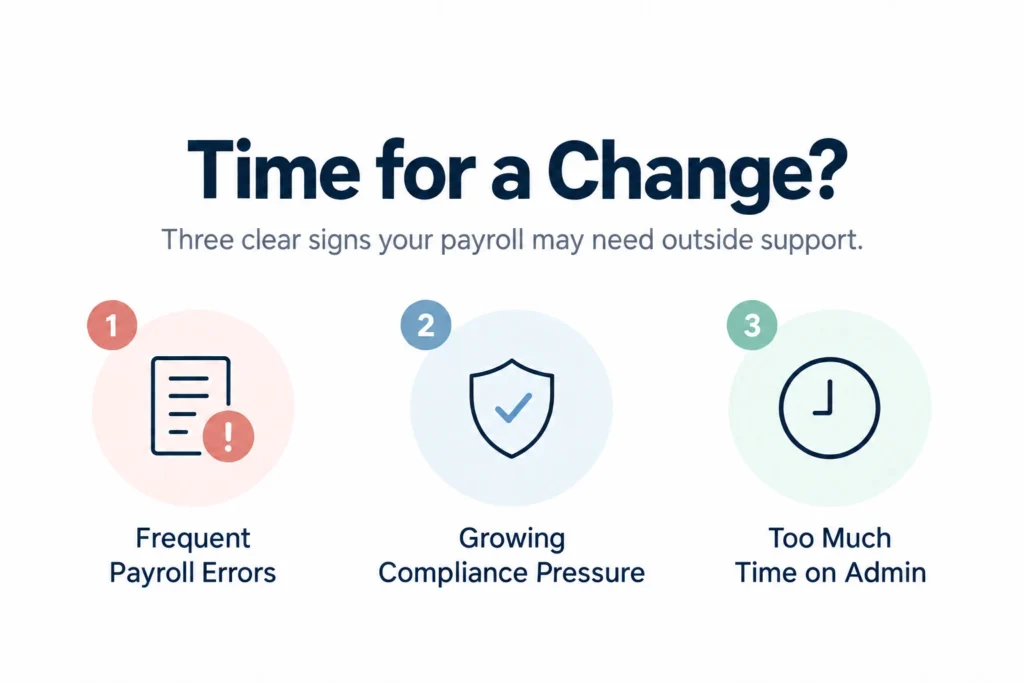
Three Signs to Outsource Payroll
A business does not need to outsource payroll merely because it reaches a particular headcount. A small company with complicated variable pay can need more payroll support than a much larger business with simple fixed salaries.
The better question is whether your internal payroll process is still accurate, controlled and easy to repeat every month. These three warning signs give a much clearer answer.
Looking for Expert Support?
Connect with our experienced team for trusted advice and dedicated assistance. We’re committed to supporting you throughout the entire process.
1. Payroll Errors and Corrections Are Becoming Routine
An occasional correction does not automatically mean payroll should be outsourced. Recurring corrections are different.
If HR or finance repeatedly has to amend salaries after the payroll run, investigate missing allowances, correct deductions or answer the same pay queries every month, the problem is usually no longer one isolated mistake. It points to weakness somewhere in the payroll process.
Typical warning signs include:
- employees regularly questioning their payslips;
- salary changes reaching payroll too late;
- overtime or attendance data being entered manually at the last minute;
- incorrect leave deductions or allowances;
- joiners and leavers being missed from the payroll cut-off;
- final settlements needing repeated recalculation;
- different spreadsheet versions being used by HR and finance; and
- corrections being made after salaries have already been approved.
The real cost is not only the incorrect amount. Every error creates additional work. Someone has to identify it, confirm the correct employee information, obtain approval, amend the payroll, explain the issue to the employee and keep the supporting record.
This is often where structured payroll outsourcing support becomes useful. The objective is not simply to move salary calculations outside the company. It is to introduce a repeatable payroll cycle with clear input deadlines, validation, review and approval before salaries are finalised.
Measure the problem before deciding
Look at your last three to six payroll cycles. How many required post-payroll corrections? How many employee queries were caused by incorrect or unclear calculations? How often did payroll depend on someone manually fixing a spreadsheet before the deadline?
If the same type of issue keeps appearing, adding more checking to the existing process may not solve the underlying problem. The process itself may need to change.
2. Payroll Compliance Is Becoming Harder for Your Team to Manage
Payroll in the GCC is not only a calculation exercise. Employers also need to apply the payroll requirements of the country where employees work.
That becomes more demanding when a business operates across several jurisdictions.
For example, UAE employers within the applicable framework manage salary payments through the Wage Protection System. Saudi Arabia operates its Wage Protection Program through Mudad. Oman also operates a Wage Protection System for private-sector establishments, while Qatar and Bahrain maintain their own wage-monitoring frameworks.
The systems are not interchangeable. Employer registration, salary data, statutory deductions, social-insurance treatment, employment rules and reporting processes need to be handled according to the relevant country.
This becomes one of the strongest signs to outsource payroll when the internal team is spending more time interpreting payroll requirements than actually controlling payroll.
Watch for problems such as:
- uncertainty about which wage-payment process applies;
- salary files being returned or requiring corrections;
- difficulty reconciling contractual salary with payroll data;
- confusion around statutory deductions or contributions;
- repeated questions about overtime, leave or final settlement calculations;
- different entities applying different payroll practices without a consistent review process; and
- the team relying on old templates even after employment or payroll rules change.
For UAE employers, dedicated WPS support can help with salary-file preparation, validation and related payroll checks where that specific issue is creating pressure.
Outsourcing does not remove the employer’s responsibility
Using an external payroll provider does not mean the employer can ignore payroll compliance. The employer still needs accurate employment records, approved salary changes, attendance information and internal authorisation.
The value of outsourcing is that payroll processing, checks, calculations and reporting can be handled through a more specialised workflow while management keeps approval and oversight.
This distinction is particularly important for multi-country GCC employers. A central HR team can maintain workforce policy and approvals while payroll processing follows the local requirements of each country.
3. Payroll Is Taking Too Much Time From HR and Finance
Payroll takes more time than the hours spent calculating salaries.
Before payroll, HR may need to collect attendance, leave, overtime, commissions, salary amendments, new-joiner information and termination details. Finance then reviews totals, confirms funding and approvals, and coordinates payment. After payroll, employees have questions, reports need reconciling and adjustments may need to be carried into the next cycle.
When that workload starts consuming several people every month, payroll is no longer a small administrative function.
Signs include:
- HR postponing other work during payroll week;
- finance spending excessive time reconciling salary data;
- payroll depending heavily on one employee who understands the spreadsheets;
- management repeatedly becoming involved in minor payroll corrections;
- monthly reports being prepared manually from multiple sources;
- payroll becoming harder whenever the person responsible is on leave; and
- employee growth immediately creating more manual administration.
The key-person issue is especially easy to overlook. If only one employee knows how payroll works, the company has a continuity risk even when the current payroll appears accurate.
Payroll should be a documented process, not knowledge stored in one person’s inbox or spreadsheet.
Where payroll problems are also tied to onboarding, employee records, leave administration and HR documentation, broader HR support can help address the inputs that feed into payroll rather than treating salary processing as an isolated task.
When Payroll Outsourcing May Not Be Necessary Yet
Outsourcing is not automatically the right answer for every company.
An internal process may still work well where the workforce is small, salaries are straightforward, payroll inputs rarely change, the team understands the applicable requirements and payroll can be completed without disrupting HR or finance.
If your company consistently processes payroll accurately, maintains clear records, has sufficient backup within the team and can keep up with local compliance requirements, there may be no urgent operational reason to outsource.
The decision should therefore be based on process pressure rather than company size alone.
What Should You Keep In-House After Outsourcing Payroll?
Payroll outsourcing works best when responsibilities are clearly divided.
The employer will normally continue controlling core employment decisions such as salary approvals, bonuses, promotions, attendance policies, leave approvals, employee changes and final authorisation of the payroll.
The outsourced payroll function can then handle the agreed processing work, which may include:
- monthly salary calculations;
- allowances and approved deductions;
- overtime and leave-related payroll inputs;
- new joiner and leaver processing;
- payslip preparation;
- payroll reports and registers;
- final settlement calculations;
- payroll reconciliation; and
- country-specific wage-payment support where included in scope.
This gives HR and finance control over decisions without requiring them to perform every repetitive processing step themselves.
A Simple Test: Is Your Payroll Still Under Control?
Before deciding, ask your HR and finance teams five practical questions:
- How many corrections did we make after payroll during the last three months?
- Could another employee run payroll tomorrow without relying on the current payroll owner?
- How many working hours does payroll take across HR, finance and management?
- Are we confident that each GCC entity follows the correct local payroll requirements?
- Can we quickly produce clear payroll records if management, an auditor or an authority asks for them?
If several answers expose recurring problems, the business has probably moved beyond the point where payroll should be treated as a simple monthly administrative task.
What Changes After Payroll Is Outsourced?
Good outsourcing should make the payroll process more controlled, not less visible.
The employer should still know which inputs are due, who approves them, when payroll is reviewed, what reports are produced and who authorises the final salary run.
The difference is that the repetitive processing and specialist checking sit within a defined workflow rather than depending entirely on internal capacity.
This can be particularly useful for GCC businesses managing different entities, salary structures and local compliance requirements. Payroll Middle East supports employers with payroll processing across the region while also connecting payroll with HR administration where the two functions overlap.
Do the Three Signs Apply to Your Business?
The decision to outsource payroll is rarely triggered by one bad month. It usually becomes clear when the same pressure keeps returning.
If payroll errors are becoming routine, compliance demands are stretching the team’s knowledge, or the monthly payroll cycle is consuming too much HR and finance time, those are practical signs that the current process needs a different structure.
The goal is not simply to outsource work. It is to create a payroll process that remains accurate, repeatable and manageable as the workforce changes.
Looking for Expert Support?
Connect with our experienced team for trusted advice and dedicated assistance. We’re committed to supporting you throughout the entire process.
FAQs