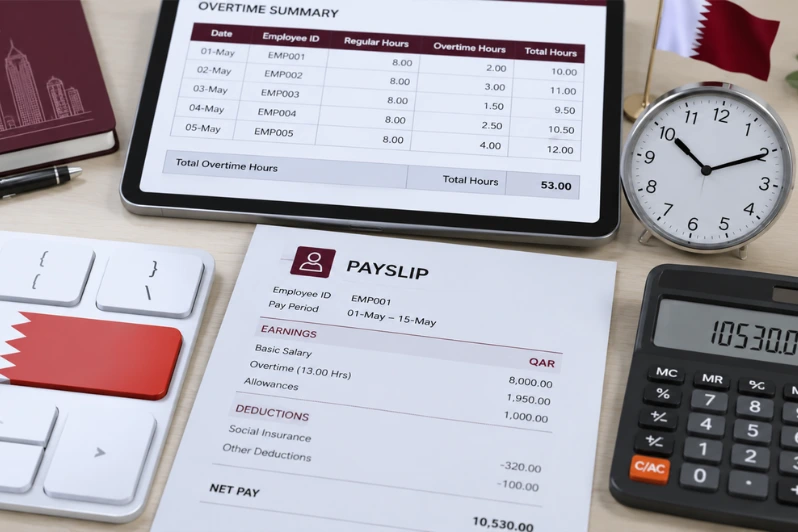
Overtime calculation in Qatar is not simply a matter of multiplying an employee’s salary by the number of additional hours worked. The employer must first identify the employee’s normal working hours, basic wage, timing of the extra work and whether the hours were worked on an ordinary day, during the night, on a weekly rest day or on an official holiday.
Errors usually occur when payroll teams calculate overtime using the employee’s total salary instead of the applicable basic wage, apply the same rate to every type of additional work or fail to separate rest breaks from actual working time.
This guide explains the overtime rules under Qatar Labour Law, the rates that may apply and how employers can build overtime into an accurate monthly payroll process.
What Is Overtime Under Qatar Labour Law?
Overtime generally refers to authorised working hours performed beyond the employee’s normal working hours.
For most workers covered by Qatar Labour Law, the normal limit is:
- Eight working hours per day
- Forty-eight working hours per week
During Ramadan, the normal limit is reduced to:
- Six working hours per day
- Thirty-six working hours per week
Hours worked beyond the applicable normal limit may qualify for overtime compensation, subject to the employee’s role, working arrangement and any statutory exception.
Looking for Expert Support?
Connect with our experienced team for trusted advice and dedicated assistance. We’re committed to supporting you throughout the entire process.
Quick Summary of Qatar Overtime Rates
| Type of Work | Minimum Treatment |
|---|---|
| Ordinary overtime | Basic hourly wage plus at least 25% |
| Work between 9:00 PM and 3:00 AM | Basic hourly wage plus at least 50%, except for workers on shift schedules |
| Weekly rest-day work | Substitute rest and enhanced compensation under Article 75 |
| Work on an official holiday | Compensation calculated under the overtime rules in Article 74 |
| Ramadan overtime | Additional hours beyond the applicable six-hour daily limit may qualify |
These are minimum statutory rights. An employment contract, collective arrangement or company policy may provide a more favourable overtime rate.
Is Overtime Calculated on Basic Salary or Total Salary?
Qatar Labour Law links ordinary overtime compensation to the employee’s basic wage for the normal working hours.
This means payroll should not automatically calculate overtime using the employee’s complete monthly package.
The employee’s total wage may contain:
- Basic wage
- Housing allowance
- Transport allowance
- Meal allowance
- Other bonuses or compensation
For statutory overtime, the starting point is generally the applicable basic wage rather than the total of all allowances. However, an employment contract or company policy may provide a more favourable calculation based on a broader salary amount.
Payroll teams should verify the employee’s salary structure before calculating the hourly rate. A payment labelled “basic salary” in an internal spreadsheet should also match the employment and payroll records.
How to Calculate the Basic Hourly Rate
For a monthly paid employee working a standard eight-hour day, a commonly used payroll method is:
Basic hourly rate = Monthly basic wage ÷ 30 ÷ 8
Qatar Labour Law establishes the minimum overtime premiums but does not expressly prescribe this exact monthly divisor in Articles 73 to 75. Employers should therefore confirm that the calculation method matches the employment terms, established payroll policy and any more favourable entitlement.
Once the hourly rate has been determined, the applicable overtime multiplier can be applied.
Ordinary Overtime Calculation in Qatar
For ordinary additional working hours, the employer must pay at least the basic hourly wage plus 25%.
The commonly used calculation is:
Ordinary overtime pay = Basic hourly rate × Overtime hours × 1.25
Ordinary Overtime Example
Assume an employee has:
- Monthly basic wage: QAR 3,000
- Normal working day: 8 hours
- Ordinary overtime worked: 12 hours
Step 1: Calculate the basic hourly rate
QAR 3,000 ÷ 30 ÷ 8 = QAR 12.50 per hour
Step 2: Apply the ordinary overtime rate
QAR 12.50 × 1.25 = QAR 15.625 per overtime hour
Step 3: Calculate the total overtime payment
QAR 15.625 × 12 hours = QAR 187.50
The employee’s estimated ordinary overtime payment would therefore be QAR 187.50.
Night Overtime Calculation in Qatar
Workers performing work between 9:00 PM and 3:00 AM are entitled to at least the applicable basic wage plus 50%.
The commonly used calculation is:
Night overtime pay = Basic hourly rate × Night hours × 1.50
The statutory night-work premium does not apply in the same way to workers operating under shift schedules. Employers should verify whether the employee is genuinely working an established shift pattern rather than classifying occasional night overtime as shift work.
Night Overtime Example
Assume the same employee has:
- Monthly basic wage: QAR 3,000
- Basic hourly rate: QAR 12.50
- Additional hours between 9:00 PM and 3:00 AM: 6 hours
Night overtime payment:
QAR 12.50 × 6 × 1.50 = QAR 112.50
The estimated night overtime payment would therefore be QAR 112.50.
What If Overtime Crosses into the Night Period?
A single overtime shift may include hours that fall under different rates.
For example, an employee may work:
- From 6:00 PM to 9:00 PM at the ordinary overtime rate
- From 9:00 PM to 11:00 PM during the statutory night period
The employer should separate the hours rather than applying one rate to the entire period.
Using a QAR 12.50 basic hourly rate:
- Three ordinary overtime hours: QAR 12.50 × 3 × 1.25 = QAR 46.875
- Two night overtime hours: QAR 12.50 × 2 × 1.50 = QAR 37.50
The total estimated overtime payment would be QAR 84.375, subject to the company’s rounding policy.
Overtime During Ramadan in Qatar
During Ramadan, the statutory normal working-hour limit is reduced to six hours per day and thirty-six hours per week for covered workers.
Where an employee works beyond the applicable Ramadan limit, the additional hours may qualify for overtime compensation.
Employers should not:
- Continue treating eight hours as the normal Ramadan day for covered employees
- Reduce the employee’s monthly wage because the statutory hours are shorter
- Ignore additional hours worked after the six-hour limit
- Combine rest intervals with actual working hours
The payroll team should maintain a separate Ramadan work schedule and ensure that attendance systems recognise the reduced normal hours.
The statutory overtime premium should then be applied to qualifying additional hours using the company’s compliant hourly-rate method.
Maximum Daily Working Hours Including Overtime
Employees may be required to work additional hours, but the total actual working time should generally not exceed ten hours per day.
An exception may apply where extra work is necessary to:
- Prevent a serious loss
- Prevent a dangerous accident
- Repair or reduce the effects of a serious loss or accident
This exception should not be used to justify routine understaffing or permanently extended shifts.
Employers should monitor employees whose attendance regularly reaches or exceeds ten actual hours. Repeated excessive hours can indicate a scheduling, workforce-planning or payroll-control problem.
Are Meal and Rest Breaks Counted as Working Time?
Normal working hours should include one or more breaks for prayer, rest and meals.
The combined break period should generally be:
- At least one hour
- No more than three hours
These breaks are not normally counted as working hours. The work schedule should also be organised so that an employee does not work for more than five consecutive hours without an appropriate interval, subject to any authorised exception for continuous operations.
This distinction matters for overtime. An employee who remains at the workplace for eleven hours may not necessarily have worked eleven payable hours if two of those hours were genuine unpaid breaks.
However, an interval should not be deducted merely because it appears on a schedule. The employer should confirm that the employee was actually relieved from work during that period.
How Is Work on a Weekly Rest Day Treated?
A covered employee is entitled to a weekly paid rest period of at least twenty-four consecutive hours. Friday is generally the weekly rest day, except for workers operating under shift schedules.
If business requirements make it necessary for an employee to work on the weekly rest day, Article 75 provides for a substitute rest day and enhanced compensation.
Weekly rest-day work should not be calculated automatically as ordinary weekday overtime. Payroll should separately identify:
- The employee’s designated weekly rest day
- The number of hours worked
- The replacement rest day provided
- The enhanced payment due under Article 75
- Any more favourable contractual entitlement
Because the statutory wording for rest-day compensation differs from the ordinary 25% overtime rule, employers should confirm the correct payroll treatment rather than simply applying the 1.25 multiplier.
Except for shift workers, employees should not ordinarily be required to work for more than two consecutive Fridays.
How Is Work on a Public Holiday Calculated?
Qatar Labour Law provides paid official holidays, including specified leave for Eid Al-Fitr, Eid Al-Adha, the national occasion identified in the law and additional days selected by the employer.
Where business conditions require an employee to work during an official holiday, the overtime provisions under Article 74 apply.
Payroll should therefore review:
- Whether the day was an official paid holiday
- The number of actual hours worked
- Whether any hours fell between 9:00 PM and 3:00 AM
- Whether a more favourable contractual holiday rate applies
Holiday work should not be recorded as an ordinary working day merely because the employee is paid a monthly salary.
Does Every Employee Qualify for the Standard Overtime Rules?
Not every worker is treated identically under Articles 73 to 75.
The standard working-hour and overtime provisions may not apply to individuals occupying key positions where their role gives them powers associated with the employer over other workers.
Special working-hour arrangements may also apply to:
- Workers performing preparatory or complementary duties before or after normal working time
- Security guards
- Cleaning workers
- Other categories identified by ministerial decision
This does not mean that every employee with “manager” in their job title can be denied overtime. The actual authority, responsibilities and position of the employee should be reviewed.
Employers should also confirm whether the employee is governed by Qatar Labour Law or a separate regulatory or employment regime.
Does Overtime Need to Be Approved in Advance?
Employers should maintain a clear overtime approval process. This helps prevent disputes over whether the additional work was requested, authorised or necessary.
A practical approval record may include:
- Date of overtime
- Start and end time
- Reason for the additional work
- Approving manager
- Employee acknowledgement
- Applicable overtime category
An employee should not normally work unauthorised extra hours simply by remaining at the workplace. At the same time, an employer should not refuse payment solely because a form was missing where management knew about, required or accepted the additional work.
The evidence and actual working circumstances should be reviewed.
How Should Overtime Appear on the Payslip?
Overtime should be shown separately on the employee’s payslip rather than being hidden within a general allowance.
A clear payslip may show:
- Basic wage
- Ordinary overtime hours
- Ordinary overtime rate
- Night overtime hours
- Night overtime rate
- Rest-day or holiday work
- Overtime amount paid
- Any approved adjustment from a previous month
This makes it easier for the employee, payroll team and management to reconcile the calculation.
Should Overtime Be Included in the WPS Salary File?
Overtime forms part of the employee’s payroll payment and should be processed and recorded accurately through the applicable salary-payment system.
The payroll register, payslip, bank file and WPS record should not show unexplained differences.
Employers should review our WPS Qatar guide for the wider salary-file process, payment deadlines and payroll-reconciliation requirements.
A technically successful WPS transfer does not correct an inaccurate overtime calculation. The employer must calculate the employee’s entitlement correctly before submitting the salary payment.
Common Overtime Calculation Mistakes
Frequent payroll errors include:
- Using total salary without checking the statutory wage basis
- Calculating every overtime hour at 1.25
- Failing to separate night hours from daytime hours
- Using eight normal hours during Ramadan
- Including genuine meal breaks as working hours
- Deducting breaks that the employee did not actually receive
- Treating Friday or weekly rest-day work as normal overtime
- Ignoring work performed on official holidays
- Applying the shift-worker exception too broadly
- Failing to update salary changes before calculating overtime
- Paying overtime without recording the hours on the payslip
- Carrying unpaid overtime forward without explanation
These errors can affect several employees at once, particularly where the incorrect formula is built into the payroll system.
Monthly Overtime Checklist for Payroll Teams
- Confirm the employee’s applicable normal working schedule
- Verify the current basic wage
- Review approved attendance and overtime records
- Remove genuine unpaid rest intervals
- Separate ordinary, night, rest-day and holiday hours
- Apply the correct statutory or contractual rate
- Check Ramadan working-hour treatment where applicable
- Review employees subject to special working-hour rules
- Compare the calculation with the previous month
- Show overtime separately on the payslip
- Include the approved amount in the payroll and salary file
- Retain attendance, approval and calculation records
What Can Employees Do If Overtime Is Not Paid?
An employee who believes overtime has been omitted should first compare:
- The employment contract
- Work schedule
- Attendance records
- Overtime approvals
- Payslips
- Salary payments
The employee should raise the discrepancy with HR or payroll in writing and identify the dates and hours in question.
If the issue is not resolved, the employee may use the applicable Ministry of Labour dispute procedure. Both parties should preserve the original attendance, scheduling and payroll evidence.
Penalties for Working-Hour and Overtime Violations
Violations of the Qatar Labour Law provisions governing normal hours, overtime and weekly rest may lead to a fine ranging from QAR 2,000 to QAR 5,000.
Under the law’s penalty framework, fines may be multiplied according to the number of workers affected.
In addition to statutory penalties, incorrect overtime practices may lead to:
- Employee wage complaints
- Payroll corrections covering several months
- Labour inspections
- Dispute-settlement proceedings
- WPS and salary-record discrepancies
- Employee-relations and retention problems
How Payroll Middle East Supports Overtime Processing in Qatar
Overtime errors often begin outside the payroll system. Attendance records may be incomplete, manager approvals may arrive late or different departments may apply different rules.
Our payroll services in Qatar help employers build a consistent process for:
- Reviewing employee salary structures
- Processing attendance and approved overtime inputs
- Separating ordinary and night overtime
- Applying Ramadan working-hour rules
- Preparing payroll registers and payslips
- Recording rest-day and holiday work
- Coordinating WPS salary-file information
- Recalculating omitted or incorrect overtime
- Maintaining payroll reports and supporting records
Outsourcing payroll does not remove the employer’s legal responsibilities. It provides a controlled process for collecting inputs, applying the approved calculation method and identifying discrepancies before salaries are released.
Calculate Overtime Before Closing Payroll
Overtime should be reviewed as part of payroll preparation, not added after the salary file has already been approved.
The employer should confirm the employee’s normal hours, basic wage, actual additional hours and the applicable overtime category before calculating the payment.
Separating ordinary overtime, night work, weekly rest-day work and official holiday work reduces errors and gives employees a clearer explanation of how their pay was calculated.
Payroll Middle East assists employers in Qatar with salary processing, overtime calculations, payslips, WPS coordination and monthly payroll reporting.
Looking for Expert Support?
Connect with our experienced team for trusted advice and dedicated assistance. We’re committed to supporting you throughout the entire process.
Frequently Asked Questions
What is the overtime rate in Qatar?
Ordinary overtime must be paid at no less than the applicable basic hourly wage plus 25%. Work between 9:00 PM and 3:00 AM must generally be paid at no less than the basic hourly wage plus 50%, except for workers operating under shift schedules.
Is overtime calculated on basic salary?
The statutory overtime provisions refer to the employee’s basic wage. An employment contract or company policy may provide a more favourable calculation based on a broader salary amount.
What is the common overtime formula in Qatar?
For an employee working a standard eight-hour day, a commonly used method is to divide the monthly basic wage by 30 and then by 8 to obtain an hourly rate. Ordinary overtime is then calculated using a 1.25 multiplier.
What are the normal working hours in Qatar?
The standard maximum is generally eight hours per day and forty-eight hours per week. During Ramadan, the limit is reduced to six hours per day and thirty-six hours per week for covered workers.
Can an employee work more than ten hours per day?
Total actual working hours should generally not exceed ten hours per day. A limited exception applies where additional work is necessary to prevent or address a serious loss or dangerous accident.
Are lunch and prayer breaks included in overtime?
Genuine prayer, rest and meal intervals are generally excluded from working hours. The employer should not deduct a break where the employee remained required to work.
Is Friday overtime calculated at the ordinary rate?
Friday is generally the weekly rest day for non-shift workers. Work performed on the designated weekly rest day is governed by Article 75 and should not automatically be calculated as ordinary weekday overtime.
Do shift workers receive the 50% night premium?
The statutory provision for work between 9:00 PM and 3:00 AM contains an exception for workers operating under shift schedules. The actual work arrangement should be reviewed before applying that exception.
Does overtime apply during Ramadan?
Yes. For covered workers, hours beyond the applicable six-hour daily or thirty-six-hour weekly Ramadan limit may qualify as overtime.
Can overtime be replaced with time off?
An employer should not use informal time off to reduce a statutory payment entitlement. Any compensatory arrangement should comply with the law and provide the employee with no less than the applicable minimum right.